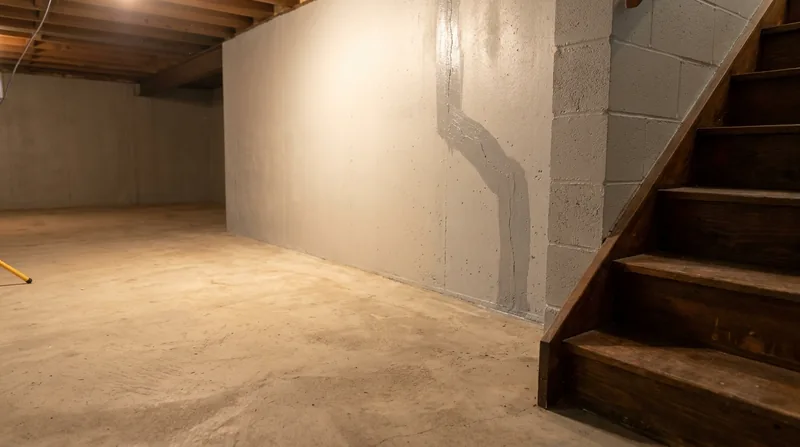




Raleigh sits on red Piedmont clay and decomposed granite that swells when it's wet and shrinks when it's dry, and that movement is what opens most of the foundation cracks we see in this city. East of town the ground shifts to sandier Coastal Plain soil with a high water table, so a wet basement in Knightdale or Clayton behaves nothing like one in Hayes Barton. We offer a Free Basement Inspection in Raleigh because the right fix depends entirely on what the water is actually doing: hydrostatic pressure pushing through a wall, a failed footing drain, or simple surface runoff from grading and downspouts. Our inspector walks the basement and the foundation perimeter, checks walls, floor, cracks, the sump system, grading and gutters, and takes photos as he goes. You get a written explanation of what needs fixing now, what can wait, and a straight answer if nothing is wrong. Start with the basement waterproofing service page if you already know water is coming in.
Why a Free Basement Inspection Matters in Raleigh's Older and Newer Basements
Raleigh's housing stock splits the problem in two. The 1900s to 1940s Victorian cottages, Craftsman bungalows and Colonial Revival homes in Oakwood, Boylan Heights, Mordecai and Hayes Barton sit on raised brick-pier or block foundations with partial or cellar-style basements that were never waterproofed to modern standards. The 1980s to 2020s two-stories with poured-concrete basements and walkouts in North Raleigh, Cary, Apex and Holly Springs were built tight, but the clay around them still moves. An inspection tells you which failure mode you have before anyone quotes a repair.
- Wall seepage and white efflorescence on the block tell you water is migrating through the masonry, not just condensing.
- A musty smell that shows up after summer thunderstorms usually points to moisture trapped behind a wall or under a floor slab.
- Water at the cove joint, where the wall meets the floor, is the classic signature of hydrostatic pressure from a rising water table.
- A sump pump that runs constantly, short-cycles, or has visibly rusted hardware is a failure waiting for the next big storm.
- Staining or a water line on the basement wall after a hurricane remnant gives you a free record of how high the water actually got.
None of that is guesswork when someone actually looks at the wall, the floor and the ground outside at the same time.
Key info: A 1920s bungalow in Boylan Heights with damp block walls and a 2015 two-story in Holly Springs with a hairline poured-wall crack are two completely different jobs. The first may need an interior perimeter drain and a vapor barrier; the second often needs epoxy injection and nothing more. The inspection is what separates them.
Raleigh permits for structural foundation repair and for work that alters drainage or the sump discharge connection vary by jurisdiction, so we always point homeowners to the City of Raleigh's development services pages at raleighnc.gov and to Wake County for unincorporated addresses. Rules change, and the local building department has the final word.
How Our Free Basement Inspection Works, Step by Step
We schedule the visit, walk the basement and the outside perimeter with you, and document everything with photos. The inspector is looking for movement, moisture and drainage paths, not trying to sell you a system before he has seen the problem. If simple crack sealing is enough, we say so. If the real issue is hydrostatic pressure, we explain why a drain tile system is the better answer than digging up the exterior. Either way, you leave the visit knowing what you have.
- We start inside the basement and check the walls for bowing, stair-step cracking, efflorescence and water staining at the cove joint.
- We look at the floor for heaving, cracks and damp patches, and check any existing drain tile, sump basin and check valve.
- We test the sump pump if one is present, listen to how it cycles, and inspect the discharge line and where it dumps.
- We walk the exterior perimeter to read the grading, downspout extensions, window wells and any sign of soil settlement against the foundation.
- We photograph each finding and write up what needs fixing now, what can wait, and what to monitor through the next storm season.
The whole visit usually takes 45 minutes to an hour, and you get the written findings before we leave.
Local example: On a 1990s two-story off Falls of Neuse Road in North Raleigh, the homeowner had a damp patch at the base of one wall every time a summer thunderstorm rolled through. The sump pump was fine and the grading was fine. What we found was a single vertical crack in the poured wall letting water through under pressure. Polyurethane injection sealed it, and no drain tile was needed. That is the kind of answer a free inspection is supposed to give.
If the inspection shows a failed footing drain or a saturated perimeter, the next conversation is usually about the interior drain tile system, which we install without excavating the exterior.
What We Check and How We Read It
Every inspection covers the same core items, but the interpretation changes with the house. A partial cellar under a 1930s bungalow in Five Points is read differently from a full poured basement in Apex, and a slab-on-grade home in Garner or Wendell gets a foundation-perimeter check rather than a basement wall check. The table below shows how we match a finding to the approach we recommend.
| Approach | Description | Best for |
|---|---|---|
| Visual walkthrough and photo documentation | Interior and exterior perimeter inspection with photos of every crack, stain and drainage issue | Every home, and the starting point for all other work |
| Sump system and discharge check | Pump cycle test, check valve inspection, discharge line route and outlet review | Homes with an existing sump basin or a history of pump failure |
| Moisture and efflorescence mapping | Locating active seepage, white mineral deposits and damp zones along walls and floor | Older block and brick foundations in Oakwood, Mordecai and Cameron Village |
| Grading and downspout review | Reading soil slope, gutter discharge points and window well condition against the foundation | Homes with water after rain but no visible wall crack |
| Written findings report | Plain-language summary of what needs fixing now, what can wait, and what to monitor | Homeowners who want a second opinion before committing to a repair |
The report is yours to keep, and you can use it to compare quotes from other contractors if you want to.
Free Basement Inspection Cost in Raleigh: What to Expect
The inspection itself costs nothing, and there is no obligation to book any repair afterward. What varies is what the inspection finds and what the fix costs, which is why we do not quote a repair over the phone. A single hairline crack that takes epoxy injection is a very different number from a full interior perimeter drain with a new sump basin and discharge line. The inspection is how we get you an honest number instead of a guess.
Several things move the cost of whatever repair follows. The size and length of the crack matters, as does whether it is a poured wall or block. Access to the basement and the exterior perimeter matters, especially on tight lots in Hayes Barton or Five Points where the side yard is narrow. Whether the sump discharge can gravity-feed or needs a pump matters. And urgency matters: water coming in during a storm is a different schedule than a crack you have been watching for a year. That is why we recommend getting two or three estimates and comparing the scope, not just the bottom line. Our full pricing overview lays out the ranges for each type of repair.
What to Look For When Hiring a Basement Waterproofing Contractor Near Raleigh
Basement waterproofing is a specialty, and a general foundation-repair firm or a plumber is not always set up for it. Ask whether the contractor is licensed and insured, and ask for the certificate rather than taking a verbal yes. Get at least two or three written estimates with the scope spelled out, and check references from jobs in your part of town, because clay soil in North Raleigh and sandy ground in Knightdale do not behave the same. Ask who pulls the permit if structural repair or drainage work requires one, and confirm the local building department's requirements before work starts. If you are in an HOA, check the architectural review rules before any exterior drainage changes.
Reach out through the contact page to schedule your free inspection, or call (984) 205-7711. If you are outside the immediate city, the service areas page shows the towns we cover across Wake and Johnston counties.
Free Basement Inspection in Raleigh: Pricing Guide
| Service | Price | Details |
|---|---|---|
| Free basement inspection | Free | Full interior and exterior perimeter walkthrough with photos and written findings, no obligation |
| Crack injection (epoxy or polyurethane) | Starting at $450 | Poured-wall crack sealed by injection; price moves with crack length and access |
| Interior drain tile system | On estimate | Perimeter drain, sump basin and discharge; linear footage and basement layout drive the number |
| Sump pump replacement | Starting at $650 | Pump, check valve and discharge line; battery backup and amperage needs move the price |
| Travel | Included | Raleigh and surrounding Wake County towns, no separate call-out or mileage fee |
| Estimate | Free | Response within 24 hours at (984) 205-7711, no obligation to book any repair |
Indicative pricing, the exact cost depends on square footage, finish, and site access. Free personalized estimate within 24h at (984) 205-7711.


