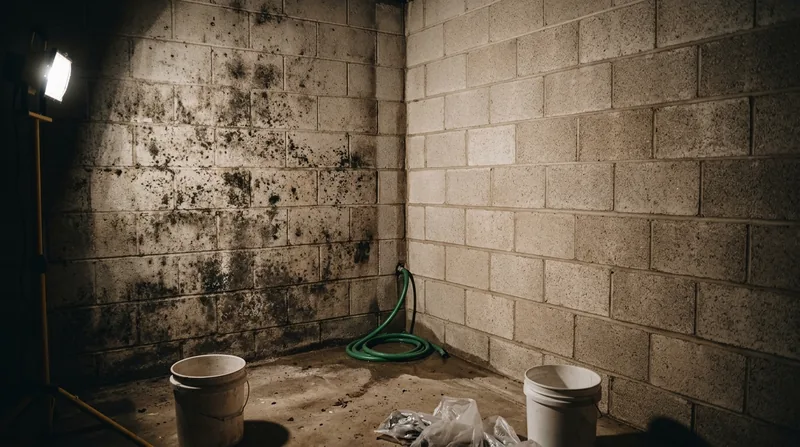




Basement Mold Remediation in Raleigh: Fix the Moisture, Not Just the Mold
If you are searching for Basement Mold Remediation in Raleigh, you already know the musty smell and the dark staining on the block or poured wall are not going away on their own. Raleigh's red Piedmont clay swells when wet and shrinks when dry, pushing hydrostatic pressure against foundations in Oakwood, Boylan Heights, and Mordecai, while the sandier Coastal Plain soil east of town keeps the water table high after every summer thunderstorm. That constant moisture is what feeds mold on framing, drywall, and floor joists. We do not just scrub the surface; we find the water path and stop it. Call (984) 205-7711 for a free basement inspection and a straight answer on what is causing the damp. For a broader look at how we keep basements dry, see our basement waterproofing service.
Why Basement Mold Remediation Matters in Raleigh's Older and Newer Homes
Raleigh's housing stock is a mix of 1900s Victorian cottages and Craftsman bungalows on brick piers with partial cellars, 1940s-1960s brick ranches on shallow lower levels, and 1980s-2020s two-stories with poured-concrete basements cut into rolling lots. Each of these foundation types fails differently. The older block walls wick groundwater and show efflorescence, while newer poured walls crack at the cold joint or around tie holes. When a sump pump fails during a July downpour, the resulting wet basement creates the perfect conditions for mold growth within 24 to 48 hours.
- Hydrostatic pressure forces water through block mortar joints and hairline cracks, keeping the wall surface damp.
- High water tables in eastern Wake County keep the footing drain saturated and push moisture upward.
- Poor grading and short downspouts dump roof runoff against the foundation, especially on older lots in Five Points and Cameron Village.
- Failed sump pumps leave the sump basin overflowing and the basement floor wet after a storm.
Every one of these conditions can be corrected, but the mold will return if the moisture source is not fixed first.
Key info: In a 1920s bungalow near Hayes Barton, we found mold on the rim joist because a downspout discharged directly against the brick pier foundation. Extending the downspout and sealing the pier joints solved the problem without major excavation.
For official guidance on mold and moisture control in homes, the U.S. Environmental Protection Agency publishes a Mold and Moisture resources page that explains why fixing the water source is the first step.
How We Approach Basement Mold Remediation in Raleigh
We start with a moisture diagnostic, not a spray bottle. Our process is built around finding the water path and correcting it before we treat any mold. That means checking the interior perimeter drain, the sump basin, the wall surfaces, and the exterior grading. We use moisture meters and thermal imaging to trace hidden dampness behind finished walls. Then we set up containment and remove or treat affected materials. Finally, we correct the drainage or humidity problem so the mold does not come back.
- Inspect and diagnose: We locate the moisture source, whether it is a failed sump pump, a cracked wall, or a blocked drain tile.
- Contain the work area: We seal off the affected space with poly sheeting and maintain negative air pressure to keep spores from spreading.
- Remove and treat: We remove porous materials that cannot be cleaned and treat structural surfaces with an antimicrobial solution.
- Correct the moisture: We repair the drainage, seal cracks, or install a vapor barrier as needed to keep the basement dry.
- Verify and prevent: We confirm moisture levels are back to normal and recommend a dehumidification strategy for Raleigh's humid summers.
This sequence ensures the remediation holds up through the next rainy season.
Local example: A 1990s two-story in Apex had mold on the bottom of the drywall after a sump pump failure during a hurricane remnant. We removed the affected drywall, treated the framing, replaced the pump with a battery backup sump pump, and added a dehumidifier to control summer humidity.
Remediation Methods We Use in Raleigh Basements
The right method depends on the extent of the mold and the moisture source. Here is how we match the approach to the problem.
| Approach | Description | Best for |
|---|---|---|
| Surface treatment and cleaning | HEPA vacuuming and antimicrobial application on non-porous surfaces like concrete and block. | Light surface mold on walls and floors with a known moisture source. |
| Containment and removal | Sealing off the area, removing mold-damaged drywall or insulation, and disposing of it properly. | Moderate to heavy mold growth on porous materials. |
| Moisture correction | Repairing drainage, sealing cracks, or installing a vapor barrier to stop water intrusion. | Any mold problem where the water source is ongoing. |
| Humidity control | Installing a dehumidifier or improving ventilation to keep relative humidity below 60%. | Raleigh's long humid summers and finished basements. |
We combine these methods as needed, and we always fix the moisture before we treat the mold.
Basement Mold Remediation Cost in Raleigh: What to Expect
Most basement mold remediation projects in Raleigh start around $1,500 for a contained area with a straightforward moisture fix. From there, the price depends on the square footage affected, the type of materials involved (finished drywall costs more to remove than exposed block), and the extent of the drainage correction needed. If we find that a failed sump pump or a cracked wall is the source, that repair adds to the total. We give you a written scope of work before we start, and we do not add surprise charges. Getting two or three estimates is smart, and you should compare what is included, not just the bottom line. For a detailed breakdown of typical ranges, see our pricing page.
What to Look for When Hiring a Basement Mold Remediation Contractor Near Raleigh
Not every contractor who offers mold remediation understands basements. You want someone who specializes in below-grade moisture, not a general handyman. Ask for proof of licensing and insurance, and verify that the company carries liability and workers' compensation coverage. Get at least two or three written estimates that specify the scope: what will be removed, how containment will be handled, and what moisture correction is included. Ask for local references, especially from neighborhoods with similar foundation types. Permits may be required for structural repairs or drainage changes, so confirm that the contractor will pull them and that the work meets Wake County and City of Raleigh building department requirements. Finally, check whether your neighborhood or HOA has any rules about exterior work or dumpster placement. When you are ready to schedule, contact us for a free estimate.
Basement Mold Remediation in Raleigh: Pricing Guide
| Service | Price | Details |
|---|---|---|
| Surface mold treatment (up to 200 sq ft) | Starting at $1,500 | Includes HEPA vacuuming, antimicrobial treatment, and a moisture inspection to identify the source. |
| Containment and removal (200 to 500 sq ft) | Starting at $2,800 | Adds poly containment, negative air pressure, and removal of mold-damaged drywall or insulation. |
| Full remediation with drainage correction | Starting at $4,500 | Combines mold removal with a sump pump replacement, crack injection, or interior drain tile repair. |
| Complex or large-scale job | On estimate | Requires an on-site inspection to assess hidden moisture, structural damage, and access constraints. |
| Travel | Included | in Raleigh and surrounding areas, no separate call-out or mileage fee. |
| Estimate | Free | Response within 24h at (984) 205-7711, no obligation to book. |
Indicative pricing, the exact cost depends on square footage, finish, and site access. Free personalized estimate within 24h at (984) 205-7711.


