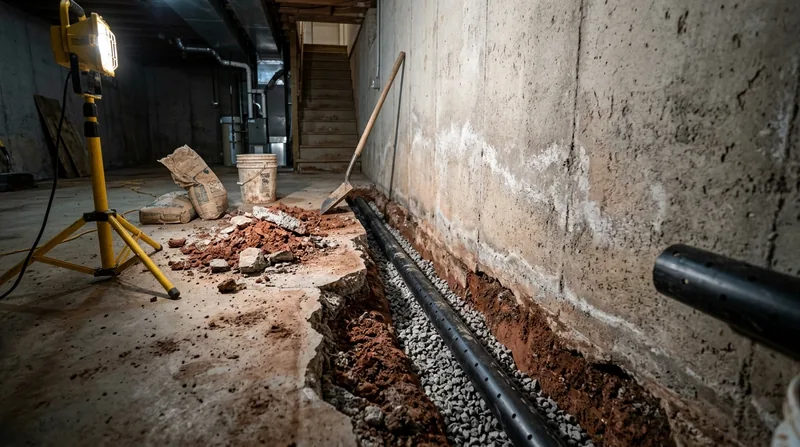




A Interior Drain Tile System in Raleigh is the most reliable way to stop groundwater from pushing up through the slab and seeping at the wall base, and it works in every season. Raleigh sits on red Piedmont clay and decomposed granite that swells when wet and shrinks when dry, so hydrostatic pressure builds fast after a summer thunderstorm or a hurricane remnant dumps three inches in an afternoon. In older neighborhoods like Oakwood, Boylan Heights, and Mordecai, the raised brick-pier and cellar-style basements were never built with a footing drain, so water simply finds the cove joint. Out east in Garner, Knightdale, and Clayton, the sandy Coastal Plain soil and high water table push water against slab edges and shallow lower levels. We cut a channel along the interior perimeter, capture that water at the footing, and route it to a sump basin and pump. If you want the full picture of how this fits with wall sealing and grading, start with our basement waterproofing service.
Why Raleigh Basements Take On Water: Clay Soil, Old Foundations, and Storm Runoff
Raleigh's building stock tells the story. The 1900s-1940s cottages and bungalows in Oakwood and Hayes Barton sit on raised brick piers with shallow cellars that have no drain tile at all. The 1940s-1960s brick ranches around Cameron Village are often slab or shallow lower level. The 1980s-2020s two-stories in North Raleigh, Cary, and Holly Springs have poured-concrete basements and walkouts cut into rolling lots, and that is where downhill runoff stacks up against the foundation. When the ground is saturated, water has nowhere to go but through the cove joint and up through cracks in the slab.
- Hydrostatic pressure builds under the slab after two or three days of rain and pushes water up at the wall-floor seam.
- Expansive clay soil swells against the foundation in wet seasons and shrinks in dry spells, opening the cove joint over time.
- Missing or failed footing drains in pre-1950 homes mean there is no perimeter collection point at all.
- Downhill runoff from rolling lots in North Raleigh and Apex concentrates against foundation walls during summer downpours.
- High water table east of town in Knightdale and Clayton keeps the soil saturated long after the rain stops.
If you see efflorescence, a musty smell, or water after every heavy rain, the pattern almost always points to a perimeter drainage problem rather than a single crack.
Key info: A 1920s bungalow in Boylan Heights with a brick-pier cellar and no footing drain will take on water at the cove joint every time Crabtree Creek backs up. An interior perimeter drain cut into the slab edge and tied to a sump basin solves that pattern without digging up the yard.
For official context on what work requires a permit, check the City of Raleigh permit and development portal before any structural or drainage alteration begins.
How We Install an Interior Drain Tile System in Raleigh
We start with a free basement inspection to confirm the water is coming from below grade and not from a failed downspout or grading issue. Then we map the perimeter, locate the footing, and set the sump basin at the low point of the slab. The work is done from inside, so we do not excavate the yard, and we can install in any season in Raleigh. Most jobs run two to four days depending on slab thickness and how much concrete we have to cut.
- We inspect the basement, test for moisture, and identify the water entry pattern.
- We cut a channel along the interior perimeter of the slab, roughly 12 inches wide, down to the footing.
- We lay perforated drain tile in a bed of washed gravel and wrap it in filter fabric to keep clay fines out.
- We set the sump basin at the low point and connect the drain tile to it.
- We install the sump pump, check valve, and discharge line, then route discharge away from the foundation.
- We backfill with gravel, patch the concrete, and test the system with water before we leave.
Every system we install is tied to a sump pump, and we recommend a battery backup for storm-season outages. You can see how that pairs with our sump pump installation service.
Key info: On a 1990s two-story in Holly Springs with a poured-concrete basement, we cut the perimeter channel, tied it to a sump basin at the low corner, and discharged to a dry well 15 feet downhill. The homeowner had been shop-vacuuming the same corner after every storm for three years.
Interior Drain Tile System Methods We Use in Raleigh
Not every basement needs the same configuration. The right approach depends on the foundation type, the water table, and whether the water is coming through the cove joint, the slab, or the wall itself. Here is how we match the method to the problem.
| Approach | Description | Best for |
|---|---|---|
| Full interior perimeter drain | Continuous channel cut along all interior walls, tied to a sump basin and pump. | Basements with water at multiple walls or across the whole floor. |
| Partial perimeter drain | Channel cut along the wet wall or walls only, tied to the same sump basin. | Isolated seepage on one side, common in Cape Cods and brick ranches. |
| Drain tile with wall vapor barrier | Perimeter drain plus a dimple board or vapor barrier on the wall face. | Walls that sweat and show efflorescence along with floor seepage. |
| Drain tile plus crack injection | Perimeter drain combined with epoxy or polyurethane injection on active wall cracks. | Poured-concrete basements with both cove-joint seepage and vertical cracks. |
| Drain tile with battery backup | Full perimeter drain with a primary pump and a battery backup pump on the same basin. | Homes that lose power during hurricane remnants and summer storms. |
We size the system to the basement, not to a template, and we tell you plainly when a simpler repair will do the job.
Interior Drain Tile System Cost in Raleigh: What to Expect
Most interior drain tile work in Raleigh starts around From $50/linear ft, and the final number depends on linear footage, slab thickness, and how many corners and obstructions we have to cut around. A 40-foot partial run on a brick ranch in Brentwood is a very different job from a 120-foot full perimeter on a walkout basement in North Raleigh. The sump basin, pump, gravel, and concrete patch are part of the scope, so ask for a line-item estimate rather than a single lump figure. We publish a fuller breakdown on our pricing page.
- Linear footage drives the base cost more than any other factor.
- Slab thickness and reinforcement in older homes can add cutting time and disposal cost.
- Sump pump and basin add to the total, and a battery backup adds more.
- Access matters in tight cellars and finished basements where we have to protect flooring and walls.
- Wall crack injection is priced separately if the walls also need sealing.
Get two or three estimates and compare scope, not just the bottom line, because a cheap quote that skips the gravel bed or the filter fabric will cost more later.
Interior Drain Tile System Near Me: How to Choose a Waterproofing Contractor Near Raleigh
You want a contractor who specializes in below-grade water control, not a general handyman or a plumber. Ask for proof of licensing and insurance, and ask whether the crew doing the work is on payroll or subcontracted. Check references from jobs in your part of Raleigh, especially if you have a brick-pier cellar or a walkout basement, because those foundations behave differently. Confirm who pulls the permit if the work alters drainage or the sump discharge connection, since rules vary by jurisdiction and the local building department has the final say. And get the warranty terms in writing before anyone cuts concrete.
- Verify the contractor is licensed and insured, and request a certificate of insurance.
- Ask for two or three local references from basements similar to yours.
- Confirm in writing who handles permits and inspections for drainage alterations.
- Read the warranty carefully and confirm it is transferable if you sell the home.
- Get a written scope that lists the gravel, filter fabric, sump basin, pump, and concrete patch.
If a contractor will not put the scope in writing, keep looking. You can reach us through our contact page to schedule a free inspection.
Interior Drain Tile System in Raleigh: Pricing Guide
| Service | Price | Details |
|---|---|---|
| Partial perimeter drain | Starting at $50/linear ft | Includes channel cutting, gravel bed, filter fabric, and tie-in to the existing sump basin. |
| Full interior perimeter drain | Starting at $65/linear ft | Continuous run around all walls with new sump basin, pump, check valve, and concrete patch. |
| Drain tile with battery backup | Starting at $85/linear ft | Full perimeter drain plus a battery backup pump on the same basin for storm-season outages. |
| Drain tile plus wall crack injection | On estimate | Combined scope needs an on-site look to count injection ports and confirm crack activity. |
| Travel | Included | In Raleigh and surrounding areas, no separate call-out or mileage fee. |
| Estimate | Free | Response within 24h at (984) 205-7711, no obligation to book. |
Indicative pricing, the exact cost depends on square footage, finish, and site access. Free personalized estimate within 24h at (984) 205-7711.


