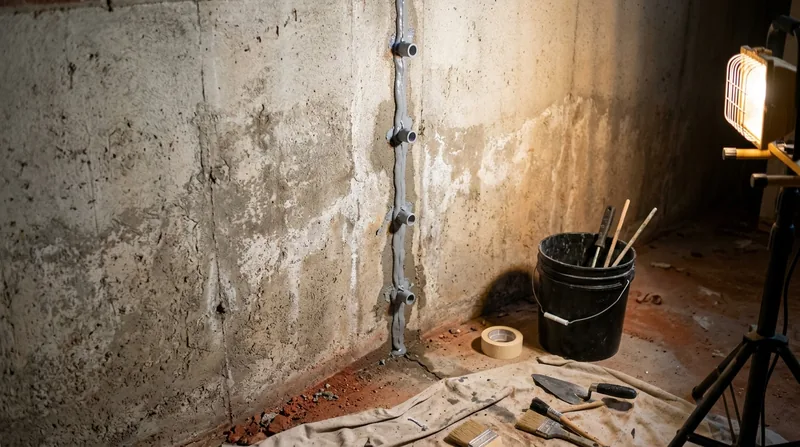




Foundation Crack Repair in Raleigh
When you need Foundation Crack Repair in Raleigh, the ground under your home is the first thing to understand. Raleigh sits on red Piedmont clay and decomposed granite that swells when it is wet and shrinks hard when it dries, so foundation walls here move with the seasons. In older neighborhoods like Oakwood, Boylan Heights, Mordecai and Hayes Barton, many homes sit on raised brick-pier or block foundations with only partial or cellar-style basements, and those walls crack along the mortar joints. Out in North Raleigh, Cary, Apex and Holly Springs, poured-concrete basements cut into rolling lots show hairline shrinkage cracks and wider diagonal cracks where the clay pushes in. We inspect every crack, match it to the right repair method, and tell you plainly when simple sealing is enough. If water is already coming through, start with basement waterproofing so the crack repair actually holds.
Why Foundation Cracks Show Up in Raleigh's Clay and Older Foundations
The dominant failure mode in Raleigh is seasonal clay movement, not frost. We get only a few freeze-thaw nights each winter, but the red clay under most of the city takes on water during summer thunderstorm downpours and hurricane remnants, expands, then shrinks through dry fall weeks and pulls the foundation wall with it. That cycle opens vertical cracks at the corners, stair-step cracks through block mortar, and horizontal cracks where hydrostatic pressure has built up behind the wall. East of town, in Garner, Knightdale, Clayton and Wendell, the soil turns sandier with a high water table near Crabtree, Walnut and the Neuse, and cracks there tend to weep after big storms.
- Vertical cracks in poured walls usually mean shrinkage or settlement and are often good candidates for injection.
- Stair-step cracks through brick or block mortar point to differential movement and need a closer structural look.
- Horizontal cracks with bowing are a pressure problem, not a sealing problem, and call for wall stabilization.
- White efflorescence and damp patches around a crack mean water is already moving through it.
Sorting the crack type before anyone touches a caulk gun is the difference between a repair that lasts and one that reopens by the next wet season.
Key info: On a 1920s bungalow in Boylan Heights, the cracks were along the block mortar above the cellar line, not in the slab. Injection alone would have failed there because the wall was moving, so we stabilized the wall first and then sealed the joints.
For official guidance on when structural foundation work needs a permit, check the City of Raleigh permits and development portal before work begins.
How We Diagnose and Repair Foundation Cracks in Raleigh
We start below grade and work from the evidence. That means reading the crack width, direction and depth, checking for efflorescence and dampness, probing the soil moisture on the outside, and looking at grading and downspout extension. We also check whether the drain tile at the footing is still moving water away from the wall. Only then do we pick a method. A tight non-structural crack gets injection. A wet, actively leaking crack gets polyurethane. A wall that has moved gets structural repair, not a patch.
- We walk the basement and foundation perimeter and map every crack with width and direction noted.
- We check moisture, efflorescence and evidence of hydrostatic pressure behind the wall.
- We inspect grading, downspout discharge and the footing drain to see where the water is coming from.
- We recommend injection, structural repair, or drainage correction based on what the crack is actually doing.
- We set injection ports, inject the resin, and confirm the crack is filled before we close out.
When the real culprit is water pressure rather than the crack itself, we say so and point you to the drainage fix instead of selling you a seal that will fail.
Key info: A 1990s two-story in Apex had a hairline crack that wept every August. The crack was minor, but the downspout dumped right at the corner and the clay stayed saturated. We extended the discharge and injected the crack, and it stayed dry through the next storm season.
If the inspection turns up a failed footing drain rather than a crack alone, the next step is usually drain tile repair and replacement.
Repair Methods We Match to Each Crack
There is no single patch that fits every crack. The table below shows how we match the method to what the wall is doing, which matters most in Raleigh where clay movement and hydrostatic pressure both show up.
| Approach | Description | Best for |
|---|---|---|
| Epoxy injection | Structural resin injected through ports to bond the crack faces back together. | Dry, stable non-structural cracks in poured concrete. |
| Polyurethane injection | Flexible foam resin that expands and seals active leaks. | Wet, weeping cracks and joints that move with the clay. |
| Structural wall stabilization | Carbon fiber straps or wall anchors to resist soil pressure. | Horizontal cracks and bowing walls under hydrostatic load. |
| Drainage correction | Grading, downspout extension and footing drain work to cut the water source. | Cracks that reopen because water keeps loading the wall. |
We choose the method from the crack evidence, and we tell you when a cheaper seal is the honest answer.
Foundation Crack Repair Cost in Raleigh: What to Expect
Foundation crack repair in Raleigh starts from $450 for a single, accessible non-structural crack handled with injection. That figure covers the common case, but the price moves with the job. A crack in a tight cellar under a 1930s bungalow in Five Points takes longer to reach than one in an open 2000s basement in Holly Springs, and that access difference shows up in the number. Active leaks, wider cracks, and cracks that come with bowing or a failed footing drain all add scope.
Tree roots are a real factor here. A mature oak or willow close to the foundation pulls moisture out of the clay and worsens seasonal shrinkage, and roots can also find their way into a footing drain. Proximity to the wall, soil type and how much water the crack is moving all change the estimate. That is why we quote after looking, not over the phone.
Get two or three estimates and compare what each one includes. A low number that only smears sealant over the surface is not the same job as injection with ports and a pressure test. Our full pricing overview breaks down the ranges so you can compare apples to apples.
Choosing a Foundation Crack Repair Contractor Near Me in Raleigh
Hiring for crack repair near Raleigh comes down to proof, not promises. Ask for the license and insurance certificate, and confirm the coverage is current. Get more than one estimate and make sure each one names the method and explains why it fits your crack. Ask for references from jobs in your part of town, because a fix that works in sandy Clayton soil is not automatically right for clay in Cary.
Ask about permits too. Structural foundation repair and work that alters drainage or the sanitary connection of a sump discharge commonly need a permit, and thresholds vary by jurisdiction, so confirm with the local building department. If your neighborhood has HOA rules on exterior work or drainage discharge, check those before the crew starts. A contractor who welcomes those questions is the one to hire. Reach us through the contact page to set up an inspection.
Foundation Crack Repair in Raleigh: Pricing Guide
| Service | Price | Details |
|---|---|---|
| Single crack injection (non-structural) | Starting at $450 | Epoxy or polyurethane injection on one accessible crack, with ports set and the crack pressure-tested before closeout. |
| Multiple cracks, same wall | Starting at $750 | Several cracks injected in one visit, priced by count and length, with access and wall condition moving the number. |
| Active leak with hydrostatic pressure | On estimate | Flexible polyurethane injection plus drainage review, since the water source usually needs correcting before the seal holds. |
| Structural repair (bowing or horizontal cracks) | On estimate | Carbon fiber straps or wall anchors priced after an on-site look at wall movement and soil load. |
| Travel | Included | In Raleigh and surrounding areas, no separate call-out or mileage fee. |
| Estimate | Free | Response within 24h at (984) 205-7711, no obligation to book. |
Indicative pricing, the exact cost depends on square footage, finish, and site access. Free personalized estimate within 24h at (984) 205-7711.


