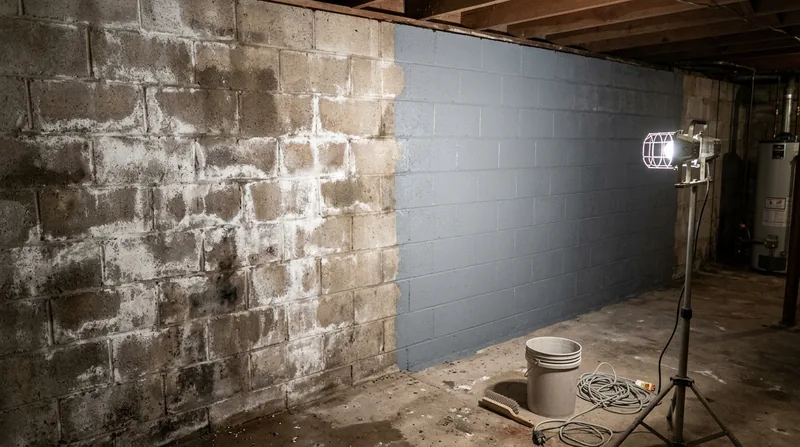




Basement Wall Sealing in Raleigh
If you own an older home in Oakwood or Boylan Heights, you already know the routine: a chalky white bloom creeps across the block foundation every spring, and the cellar smells like wet brick by July. Basement Wall Sealing in Raleigh starts with an honest look at what is actually pushing moisture through those walls. Our ground here is red Piedmont clay and decomposed granite that swells when it is wet and shrinks hard when it dries, and that movement opens the hairline cracks and porous mortar joints that let water in. We prep the surface, remove efflorescence, and apply penetrating or membrane sealers that stop dampness at the wall face. But we also tell you plainly when a sealer is the wrong tool and hydrostatic pressure is the real problem. Call (984) 205-7711 to schedule a free basement inspection, and we will show you which failure mode you are dealing with. You can also read our full basement waterproofing overview to see how sealing fits into a complete system.
Why Basement Wall Sealing Matters in Raleigh's Clay and Older Foundations
Raleigh sits on some of the most active residential soils in the Southeast. The red clay under Five Points and Cameron Village holds water against the foundation long after a storm passes, and the sandy Coastal Plain ground east toward Knightdale and Clayton sits on a high water table that keeps block walls permanently damp. Add the raised brick-pier and partial cellar foundations common in Mordecai and Hayes Barton, and you get walls that wick moisture straight into the mortar. Sealing is the first line of defense, but it only works when we match the product to the wall.
- We remove efflorescence and loose parging before any sealer touches the wall, because sealing over salt bloom traps the moisture behind it.
- We test for active seepage and hydrostatic pressure so you do not pay for a coating that fails in the first heavy thunderstorm.
- We apply penetrating silane and siloxane sealers on porous block and brick, and elastomeric membranes on poured concrete walls where hairline cracking is present.
- We flag the cases where sealing is cosmetic only and an interior perimeter drain is the honest answer.
Every wall we seal gets a moisture reading before and after, so you know whether the product is doing its job or whether the water is coming from below the footing.
Key info: A 1920s Craftsman bungalow in Boylan Heights with a chalky block cellar wall is a classic sealing candidate. A 1990s poured-concrete walkout in Apex with water pooling at the cove joint after every summer downpour is not. Sealing that wall would only trap moisture and push the problem sideways into the floor slab.
If you want to understand the building codes and permit thresholds that apply to foundation and drainage work in our area, the City of Raleigh's permit portal is the authoritative starting point: raleighnc.gov/permits.
How We Seal Basement Walls in Raleigh, Step by Step
Sealing is not a spray-and-go job. The prep work decides whether the sealer lasts five years or fifteen, and on Raleigh's swelling clay, surface condition changes with the season. We follow a fixed sequence on every wall, whether it is a 1940s brick ranch near Brentwood or a newer two-story in Holly Springs.
- We walk the exterior grade and downspout discharge first, because no sealer holds back a gutter dumping water at the foundation.
- We wire-brush and scrape the wall to remove efflorescence, loose parging, and old failing coatings.
- We fill non-structural cracks and honeycombs with hydraulic cement or epoxy injection before sealing.
- We apply the sealer in two passes, allowing proper cure time between coats.
- We check the cove joint and footing line for active seepage and document any that we find.
- We leave you a written note on what was sealed, what was not, and what to watch for next wet season.
If the inspection turns up a wall that is bowing or a footing drain that has collapsed, we stop and talk to you about foundation crack repair before we sell you a sealer.
Key info: On a 1950s Cape Cod off Glenwood Avenue, we found efflorescence on the interior block wall but no active seepage. A penetrating sealer and a downspout extension solved the dampness. Two streets over, a poured wall with water at the cove joint needed an interior drain tile system, and we said so instead of coating the wall.
Sealing Approaches We Use on Raleigh Basement Walls
Different wall assemblies need different products. We carry penetrating sealers, membrane coatings, and crystalline systems because one product does not fit a 1920s brick cellar and a 2015 poured wall in Wake Forest. The table below shows what we use and when.
| Approach | Description | Best for |
|---|---|---|
| Penetrating silane/siloxane sealer | Soaks into porous block and brick, reacts with the substrate, and blocks capillary wicking without leaving a film. | Damp, chalky block walls in older Raleigh cellars with no active water flow. |
| Elastomeric membrane coating | A flexible rubberized film that bridges hairline cracks and resists minor movement. | Poured concrete walls with shrinkage cracks and intermittent dampness. |
| Crystalline waterproofing | A cementitious coating that grows crystals into the concrete pores and seals against low-pressure seepage. | Damp concrete walls and cold joints where a film coating would peel. |
| Crack injection plus sealing | Polyurethane or epoxy injection fills the crack, then the wall face is sealed to close the surrounding pores. | Walls with visible vertical cracks that weep during heavy rain. |
We choose the approach after we see the wall, not before. If a wall needs more than a sealer, we tell you what the real fix is and what it costs.
Basement Wall Sealing Cost in Raleigh: What to Expect
Most residential basement wall sealing jobs in Raleigh start at From $1,500, and that figure covers a typical single-wall or small cellar with surface prep, efflorescence removal, and two coats of sealer. Larger basements, heavy parging repair, or crack injection work push the number up, and we quote those after a site visit. We do not give a firm price over the phone because a 1920s brick-pier cellar in Mordecai and a 2005 poured wall in Cary are not the same job.
Several factors move the price: square footage of wall surface, how much efflorescence and old coating has to come off, whether cracks need injection first, and access around the foundation. If the honest answer is that sealing will not solve your problem, we will tell you before you spend the money. You can see how sealing compares to full waterproofing on our pricing page.
Get two or three estimates and ask each contractor what they found at the wall. A price without a diagnosis is just a number.
Basement Wall Sealing Near Me: How to Choose a Contractor Near Raleigh
Hiring the right contractor matters more than the brand of sealer. Ask for proof of license and insurance, and do not accept a verbal yes. Call references from jobs in your part of town, and ask whether the wall stayed dry through a full summer. Get at least two written estimates that describe the prep work, not just the coating. And confirm who pulls any permit if the job touches drainage or structural repair, because rules vary by jurisdiction and the local building department has the final word.
We are a dedicated basement waterproofing specialist, not a general handyman or a plumber. That means we diagnose the wall first and sell you a sealer second. If you want to talk through what you are seeing, reach out through our contact page or call (984) 205-7711. We will schedule a free inspection and give you a straight answer on whether sealing is enough.
Homeowners in the 27603 zip code can also see local project notes on our Basement Wall Sealing in Raleigh (27603) page.
Basement Wall Sealing in Raleigh: Pricing Guide
| Service | Price | Details |
|---|---|---|
| Single wall sealing, small cellar | Starting at $1,500 | Includes surface prep, efflorescence removal, and two coats of penetrating sealer on one wall. |
| Full basement wall sealing | Starting at $2,800 | Covers all interior wall surfaces with prep and sealer; price rises with square footage and parging repair. |
| Crack injection plus sealing | Starting at $2,200 | Polyurethane or epoxy injection of active cracks before sealing; number of cracks drives the total. |
| Complex or large-scale job | On estimate | Multiple walls, heavy coating removal, or structural concerns need an on-site look before we quote. |
| Travel | Included | We cover Raleigh and surrounding areas with no separate call-out or mileage fee. |
| Estimate | Free | Response within 24 hours at (984) 205-7711, with no obligation to book the work. |
Indicative pricing, the exact cost depends on square footage, finish, and site access. Free personalized estimate within 24h at (984) 205-7711.


