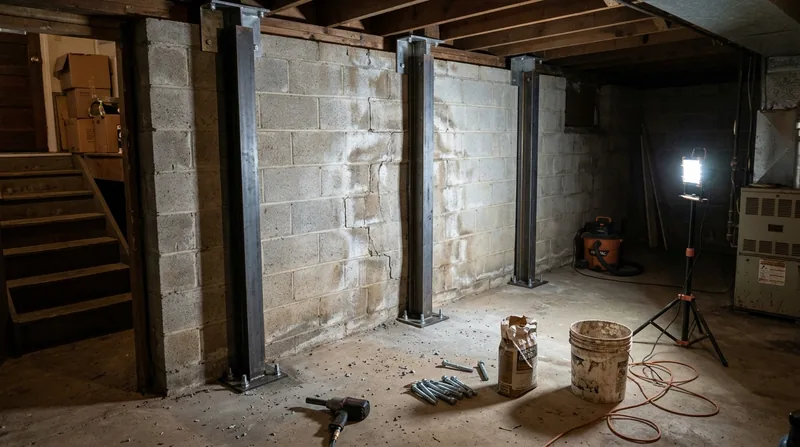




Bowing Wall Repair in Raleigh
Raleigh's red Piedmont clay swells hard against a foundation wall after a wet spring, then shrinks and pulls back in a dry July, and that cycle is what pushes block and poured-concrete basement walls out of plumb across the city. If you have spotted a Bowing Wall Repair in Raleigh problem, you are looking at a structural movement, not a cosmetic crack, and it needs a real assessment before the wall travels further. The homes most at risk here are the 1980s to 2020s two-stories with poured basements cut into the sloped lots of North Raleigh, Cary, and Holly Springs, where saturated clay backfill presses hard against the wall. Older block foundations around Oakwood and Boylan Heights can lean too, though many of those sit on raised brick piers with only partial cellars. We handle the below-grade side of this work: diagnosis, stabilization, and drainage correction. Start with a free basement inspection and we will tell you plainly how far the wall has moved.
Why Bowing Walls Are Common in Raleigh's Clay and Sloped Lots
Most bowing walls we open up in Raleigh trace back to the same two forces working together: hydrostatic pressure from saturated clay backfill, and a footing drain that stopped carrying water years ago. When the original weeping tile clogs, water stacks up behind the wall instead of running to daylight, and the clay backfill stays saturated long after the storm passes. On a sloped lot in North Raleigh or Apex, downhill runoff from the neighbors' yards adds to that load.
- Poured-concrete walls crack horizontally near mid-height when the backfill load exceeds what the wall was designed to carry.
- Concrete block walls shear along the mortar joints and stair-step, which is the pattern we see most in mid-century block foundations.
- Clay soil that stays wet through a rainy winter keeps constant pressure on the wall, while a dry summer lets the soil shrink and the wall relax.
- A failed footing drain or a downspout dumping at the foundation corner accelerates movement on the uphill side of the house.
- Efflorescence and white mineral staining at the base of the wall usually means water is moving through the concrete, not just sitting against it.
If you see any of these signs, get the wall measured and monitored before you spend money on cosmetic patching.
Key info: A home in the Five Points area with a 1960s block basement had a wall leaning about 1.5 inches over eight feet. The cause was a clogged footing drain on the uphill side and clay backfill that never dried out. Carbon fiber straps alone would have masked the movement, so we corrected the drainage first, then stabilized the wall.
For the official view on structural permits in this area, check the City of Raleigh permitting resources before any structural repair begins, because thresholds vary by jurisdiction.
How We Diagnose and Stabilize a Bowing Wall in Raleigh
We do not quote a bowing wall repair from a photo. The first step is a site visit where we measure the wall's plumb, map the crack pattern, and check how the water is actually behaving behind the wall. From there we match the repair to the severity of the movement and to the soil on your lot, because a wall pushed by saturated clay needs a different answer than one that has simply settled.
- We measure the wall deflection at several heights and record the crack widths so we have a baseline to compare against.
- We inspect the footing drain, sump basin, and downspout discharge to find out whether water is still loading the wall.
- We recommend the right stabilization method: carbon fiber straps for moderate bowing, steel I-beams for heavier loads, or wall anchors where the wall is moving inward and the soil outside allows it.
- We correct the water source with drainage work so the repair is not fighting a saturated backfill.
- We seal the wall and document the finished deflection so you have a record of the repair.
Every repair we do is matched to the actual load on the wall, not to a one-size template.
Key info: In a Holly Springs walkout basement, the rear wall had bowed about an inch where the lot slopes down to the rear. We installed carbon fiber straps on the interior and corrected the surface grading and downspout extensions outside. The wall has held its position since, and the homeowner has a documented baseline for future checks.
If the inspection shows the water source is the real driver, we will walk you through exterior basement waterproofing and drainage correction as the companion to the structural repair.
Stabilization Methods We Use and When Each One Fits
The method has to match the wall material, the amount of movement, and how much room you have on the interior and exterior. Here is how we sort it in the field.
| Approach | Description | Best for |
|---|---|---|
| Carbon fiber straps | Straps bonded to the interior wall face and anchored top and bottom to resist further inward movement. | Moderate bowing on block or poured walls with limited deflection. |
| Steel I-beams | Vertical steel beams set against the wall and tied into the floor and footing to carry heavy lateral load. | Walls with significant movement or high clay backfill pressure. |
| Wall anchors | Anchors driven into stable soil outside and connected through the wall to plates inside. | Walls moving inward where exterior access is available. |
| Drainage correction | Clearing or replacing the footing drain and redirecting downspouts and surface water away from the wall. | Any bowing wall where hydrostatic pressure is still loading the wall. |
In most Raleigh jobs we combine a structural method with drainage correction, because one without the other leaves the wall under the same load.
Bowing Wall Repair Cost in Raleigh: What to Expect
Bowing wall repair starts at $600 for the smallest scopes, such as a limited strap installation on a short wall section with no drainage work. Most full stabilizations run well above that, and the number depends on how far the wall has moved, how many linear feet need support, and whether the drainage has to be corrected at the same time. A single wall in a Cary basement with moderate bowing is a different job from a three-wall repair in a North Raleigh walkout.
Access matters too. A wall behind finished drywall, a furnace, or a water heater takes more labor to reach, and exterior anchor work depends on what is planted or built outside the wall. Soil conditions on your lot also drive the method, since heavy clay backfill may call for steel rather than straps. That is why we measure before we quote and why getting two or three estimates on a structural repair is smart. Compare what each contractor proposes to do about the water, not just the wall.
Our full pricing overview lays out the ranges so you can see where your job likely falls before we visit.
Bowing Wall Repair Near Me: How to Choose a Contractor Around Raleigh
When you search for bowing wall repair near me, the list you get is mostly general foundation firms and a few waterproofing specialists. Ask each one what they will do about the water behind the wall, because a contractor who only bolts straps on without addressing the saturated clay is selling you half a repair. Here is what to check before you sign.
- Confirm the company is licensed and insured, and ask for a certificate of insurance before work starts.
- Get two or three written estimates that specify the method, the linear footage, and whether drainage correction is included.
- Ask for references from jobs in Raleigh or the surrounding towns with the same wall type and soil conditions.
- Ask who pulls the permit if structural work is required, since the City of Raleigh building department sets the threshold and rules vary by jurisdiction.
- Check any HOA requirements for exterior work, especially anchor installations that show on the outside of the wall.
A contractor who measures the wall and explains the water source is the one worth hiring.
Reach out through our contact page to schedule a free inspection and get a straight answer on what your wall needs.
Bowing Wall Repair in Raleigh: Pricing Guide
| Service | Price | Details |
|---|---|---|
| Limited carbon fiber strap repair | Starting at $600 | Covers a short wall section with minimal deflection and no drainage correction included. |
| Full wall carbon fiber stabilization | Starting at $2,400 | Straps across the full bowed wall, anchored top and bottom, with deflection documented before and after. |
| Steel I-beam or wall anchor system | Starting at $4,800 | Heavier lateral loads and significant movement, priced by linear footage and exterior access. |
| Combined structural and drainage repair | On estimate | Needs an on-site look because footing drain condition and soil load vary by lot. |
| Travel | Included | In Raleigh and surrounding areas, no separate call-out or mileage fee. |
| Estimate | Free | Response within 24h at (984) 205-7711, no obligation to book. |
Indicative pricing, the exact cost depends on square footage, finish, and site access. Free personalized estimate within 24h at (984) 205-7711.


